By Kristen Ribero
VP of Marketing at unitQ

The short answer. The best customer feedback tool depends on the job you are hiring it for.
For real-time feedback intelligence across every channel, with an objective quality score and root-cause analysis, unitQ is the strongest pick. For CX text analytics and dashboards, Chattermill is a capable choice. For large enterprise experience-management programs, Qualtrics and Medallia lead. For lightweight survey collection, SurveyMonkey and Typeform do the job well.
Most “best tools” lists rank these as if they were the same product. They are not, and choosing well starts with naming which problem you actually have.
Your customers are telling you exactly what is broken. The problem is you are not hearing it, at least not fast enough to act. Surveys pile up. App store reviews scroll by. Support tickets close without anyone connecting the dots. By the time a pattern reaches the roadmap, the churn it caused is already priced in. The tool you choose decides whether that signal reaches the right team in hours or never.
“Customer feedback tool” is a category label stretched across products that do genuinely different work. Some collect feedback. Some analyze it. A smaller group turns it into decisions. Treating them as interchangeable is the single most common mistake buyers make, because it leads to comparing a survey builder against a real-time intelligence platform on price, then wondering why the cheap option left the hard problem unsolved.
Three jobs sit under the one label. Collection tools put questions in front of customers and gather the answers: surveys, forms, in-app prompts. Analysis tools take feedback you already have and find themes, sentiment, and trends in it. Intelligence tools do both continuously and close the loop, connecting what customers say to what it costs and what to do next.
A team that buys a collection tool to solve an analysis problem has chosen the wrong category of product, and no rival survey tool will fix that.
The cost of not hearing customers has risen sharply. Forrester’s 2024 CX Index found that 39% of US brands saw customer experience quality significantly decline in 2024, only 3% qualified as customer-obsessed, and average CX effectiveness sat at 64%. The same research found that customer-obsessed companies achieve 41% faster revenue growth, 49% faster profit growth, and 51% better retention than their peers.
Both groups work hard at this; nearly every company runs surveys and reads reviews. What separates them is speed and specificity: whether feedback becomes a decision fast enough to matter, and precise enough to ship. That’s a tooling problem as much as a culture one, which is why the category is being rebuilt around intelligence rather than collection.
Six dimensions separate a tool that informs decisions from one that just stores responses.
Does it see every place customers speak, app store reviews, support tickets, social, surveys, and chat, or only the ones you explicitly send? Feedback you never collect is a blind spot no analysis can recover.
Does an emerging issue surface in hours, or in the next quarterly report? Real-time detection is the difference between catching a bad release and reading about it in your churn numbers.
Can it move past sentiment to root cause, telling you not just that users are unhappy but which specific issue is driving it and where? Sentiment is a thermometer. Root cause is a diagnosis.
Is there an inspectable, benchmarked score you can track over time and across competitors, or only internal charts that mean nothing outside the room?
Does a finding route to the team that owns the fix, in the tools they already use, or does it die in a dashboard nobody opens?
Can it tie a quality issue to its business impact, so a fix competes for engineering time on evidence rather than on the loudest voice in the room?
Mapped against those criteria, the market sorts into four groups.
Survey and form tools (SurveyMonkey, Typeform) are accessible and fast to stand up, built for collecting structured responses to questions you already know to ask. Their limit is that they only hear what you think to ask about, and analysis is shallow.
Legacy voice-of-customer suites (Qualtrics, Medallia) are enterprise-grade and broad, built for large, cross-functional experience programs. Their limit is weight: implementation often runs months, and product teams frequently find them heavier than the job requires.
CX and text analytics (Chattermill, and tools like InMoment) are stronger on theming and visualization of existing feedback, aimed at CX and insights teams. Their limit is that analysis and continuous, real-time monitoring are different jobs, and most in this group lean toward the former.
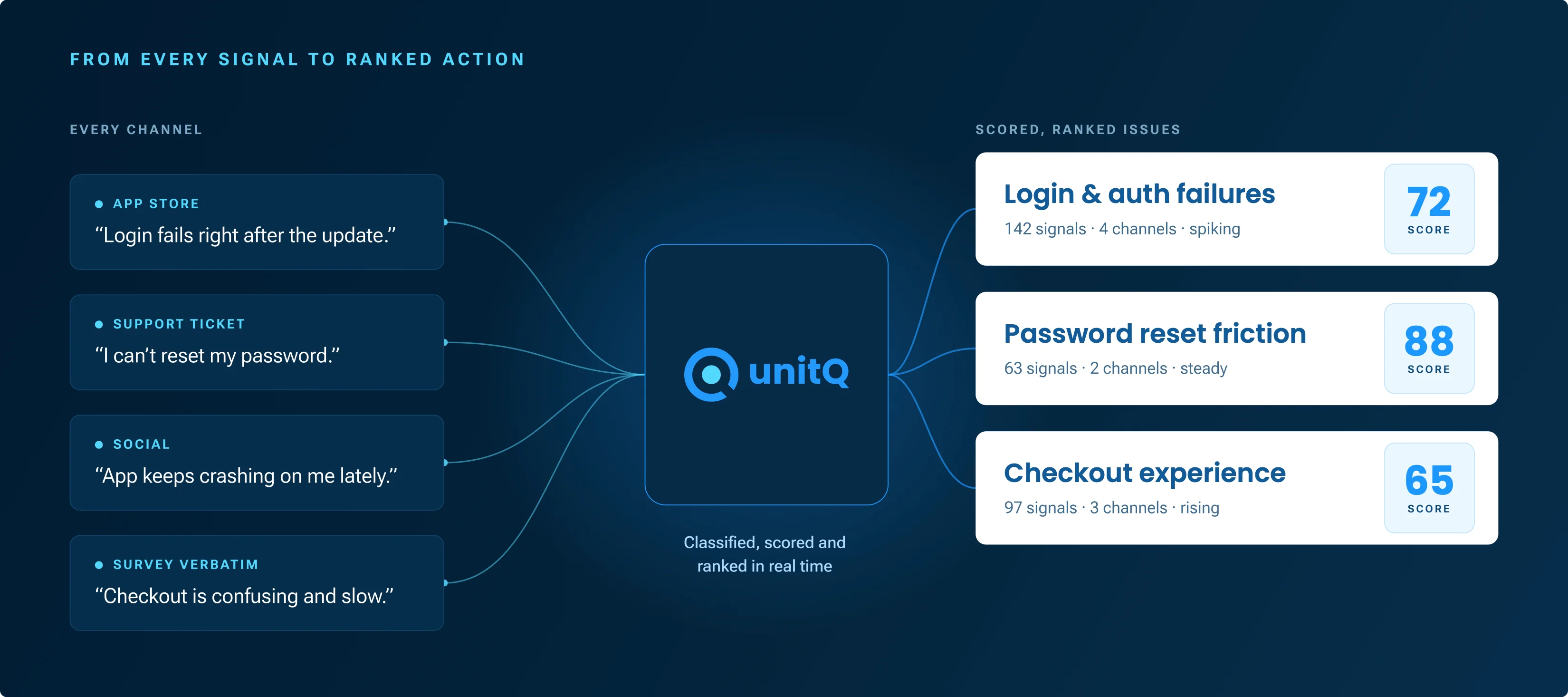
Feedback intelligence platforms (unitQ) treat feedback as a live signal across every channel, classify it continuously against an objective score, and connect it to root cause and business impact. This is the newest group, and the one built for the speed-and-specificity gap Forrester describes.
The tools most teams shortlist are built for genuinely different jobs. Use the comparison below as a map of which job each one is built for, because the right answer changes with the problem you are solving. Narrative detail on each follows.
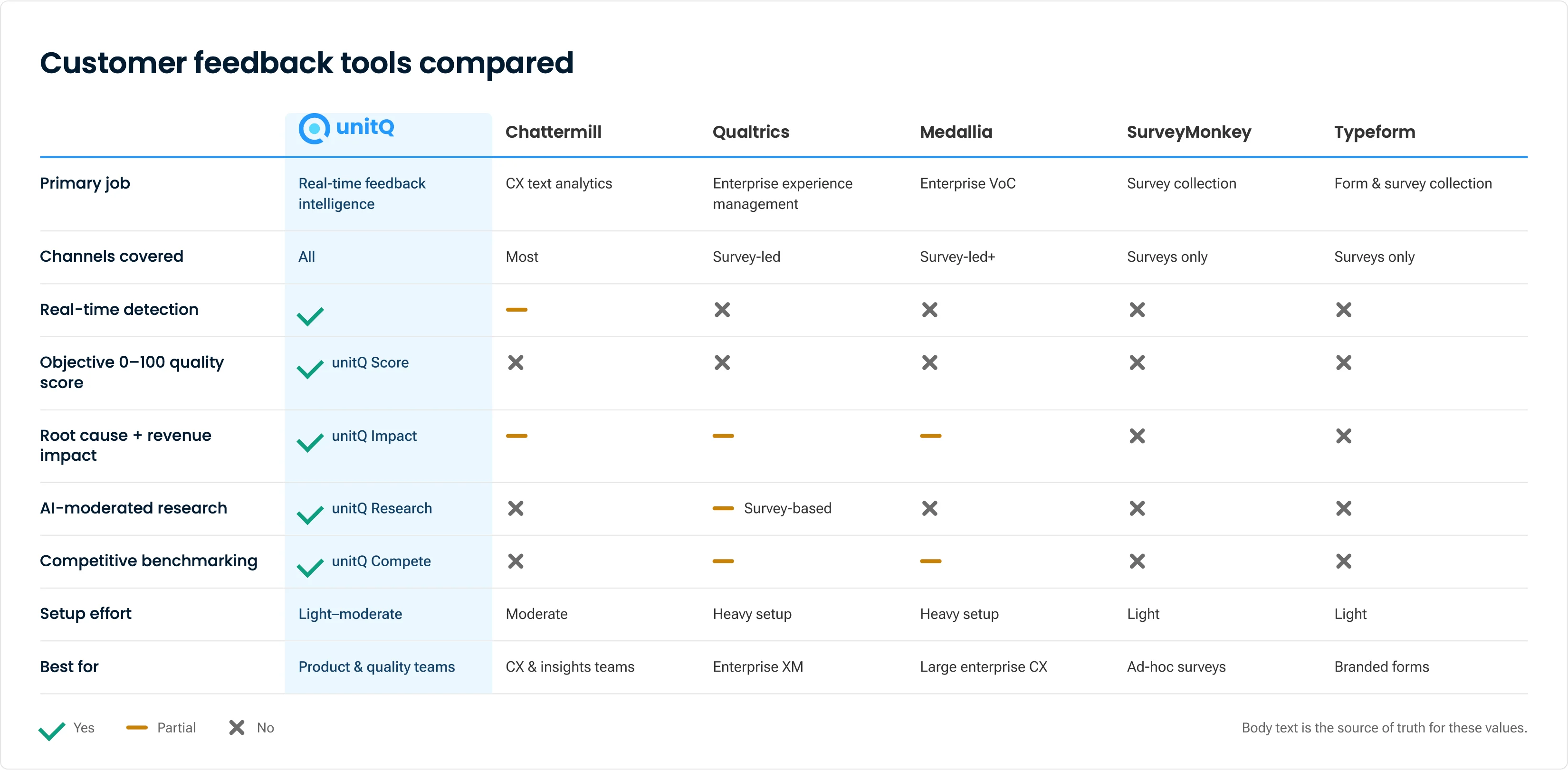
unitQ is a feedback intelligence platform that treats customer feedback as a real-time signal rather than a periodic report. unitQ Monitor ingests app store reviews, support tickets, social posts, survey verbatims, and chat, classifies them continuously against an adaptive taxonomy, and scores product quality on an objective 0–100 unitQ Score you can track over time and against competitors. unitQ Impact ties an issue to its business cost so fixes compete on evidence, and unitQ Research adds AI-moderated interviews when you need depth the signal alone cannot give. Its analysis is grounded in real data at scale: unitQ's study of 67.7 million real user signals found that complaints about UI navigation outnumber feature requests six to one, the kind of finding that reorders a roadmap.
unitQ goes past sentiment to connect what customers say to what it costs, and what to do about it. The honest limits: it is not a lightweight survey builder, and it earns its keep at organizations with real feedback volume rather than a team running three surveys a quarter.
→ Best for: product and quality teams that need to catch issues in real time and connect them to revenue. See how unitQ works.
Chattermill is a CX analytics platform known for strong theming and visualization of existing feedback, aimed at customer experience and insights teams that want to understand sentiment and trends across their channels. Its dashboards are a genuine strength.
The trade-off is that continuous, real-time monitoring and an objective, benchmarked quality score are not its center of gravity. Teams weighing the two can read the full unitQ vs Chattermill comparison.
→ Best for: CX and insights teams focused on analyzing and visualizing feedback they already collect.
Qualtrics is the enterprise experience-management standard, broad and deeply configurable, built for large programs spanning customer, employee, product, and brand experience. For an organization standing up a company-wide XM practice, it is a defensible choice.
The trade-off is weight and survey-led design: implementation is a project measured in months, and product teams often find it heavier than their question requires. See the unitQ vs Qualtrics comparison for where a lighter, signal-led approach fits better.
→ Best for: enterprises running formal, cross-functional experience-management programs.
Medallia is an enterprise voice-of-customer platform with deep roots in large-scale CX measurement, strong in contact-center and omnichannel experience programs at scale.
Like Qualtrics, its trade-off is scope and setup: it is built for enterprise breadth rather than product-team speed. The unitQ vs Medallia comparison covers the difference in depth.
→ Best for: large enterprises with dedicated CX operations.
SurveyMonkey is one of the most accessible survey tools available, fast to stand up and familiar to almost everyone. For sending a questionnaire and getting structured answers back, it works well.
Its limit is the category boundary: it collects, it does not continuously analyze multi-channel feedback or connect it to product decisions. It works best alongside an intelligence platform, handling collection while the platform handles the analysis.
→ Best for: teams that need straightforward survey collection.
Typeform is a survey and form tool distinguished by conversational, well-designed forms that lift completion rates, a strong fit where the survey experience is part of the brand.
Its boundary is the same as SurveyMonkey’s: excellent collection, minimal analysis, no continuous multi-channel signal.
→ Best for: teams that want branded, high-completion forms and surveys.
The through-line across every category above is that the market is moving from collection to intelligence. Collecting feedback is close to solved; almost every company has more of it than it can read. The scarce capability is turning that flood into a decision fast enough to matter, which is why the newest tools compete on speed, specificity, and the connection to revenue rather than on how many question types they support.
This is also why old evaluation criteria mislead. A comparison built around form design, dashboard count, or survey logic ranks yesterday’s tools well and tells you nothing about which one will actually change what your team ships next sprint. The right questions are the six above, and most of them are about what happens after the feedback arrives.
Start by naming your bottleneck. Budget comes after. If you can’t get customers to respond, you have a collection problem, and a survey tool is the cheapest fix. If feedback piles up unread, you have an analysis problem, and a CX analytics tool or an intelligence platform earns its cost. If issues reach the roadmap too late and without a clear owner, you have an intelligence problem, and only a platform that monitors continuously and connects to impact will close it.
Most teams past a certain scale have the third problem and buy for the first, which is how a company ends up with three survey tools and the same blind spot it started with. Match the category to the bottleneck, weigh each candidate on the six criteria, and the shortlist tends to pick itself. For a deeper look at the landscape, see our guides to the best voice of customer platforms and the best customer feedback analysis tools.
Ready to see feedback from every channel become real-time, root-cause insight on your own data?

Join product and CX leaders getting the latest on customer intelligence, once a month.